AI-native engineering
Design chips you can trust.
Daedyl is an AI-native engineering environment for semiconductor design. Design, simulate, optimize, validate, and prove your work with Daedyln, an AI engineering agent that works alongside you throughout the engineering process.
- AI-native engineering
- Human-controlled
- Evidence-backed
Sample project. Values from a recorded simulation, not a measured chip.
One engineering environment
Design. Simulate. Optimize. Prove.
Move from engineering intent to validated results in one AI-native environment, without losing context between tools, models, decisions, or evidence.
Design across abstraction levels
From requirements and architecture to schematics, RTL, layout and implementation with Daedyln working in context.
See how the design behaves
Run circuit, RF, electromagnetic, thermal and device analysis without leaving the engineering environment.
- S21 28.6 dB
- S11 -12.2 dB
- S22 -12.1 dB
- at 10.000 GHz
Know what supports every result
Connect requirements, decisions, artifacts, simulations, results and approvals into an auditable engineering record.
- REQ-001Gain ≥ 25 dB
- DEC-017Cascoded LNA
- SIM-042AC simulation
- RES-071Gain 28.6 dB
- APP-012Design review
From intent to evidence
One continuous engineering workflow.
Daedyl maintains engineering context as work moves from an idea to implementation, simulation, optimization, and validation. Daedyln works across that entire lifecycle rather than operating as a separate chatbot.
- 01
Define
Requirements
- 02
Design
Schematic / RTL
- 03
Build
Layout / Implementation
- 04
Simulate
Circuit / EM / Thermal
- 05
Optimize
Explore trade-offs
- 06
Validate
Evidence / Approvals
In 3D
See the chip you designed, layer by layer.
Daedyl turns a project's own routed layout into a 3D model: every metal layer, via and standard cell, taken from the recorded GDS and placement. Pull the stack apart, isolate a layer, follow a net from the code to the silicon, or render it for a design review.
Interactive in the app
Drag, zoom and explode the stack, switch layers on and off, and click any cell to see what it is and where it came from in the RTL.
Assurance on the geometry
Colour the chip by what matters: radiation-hardened copies and voters, timing paths, power or temperature.
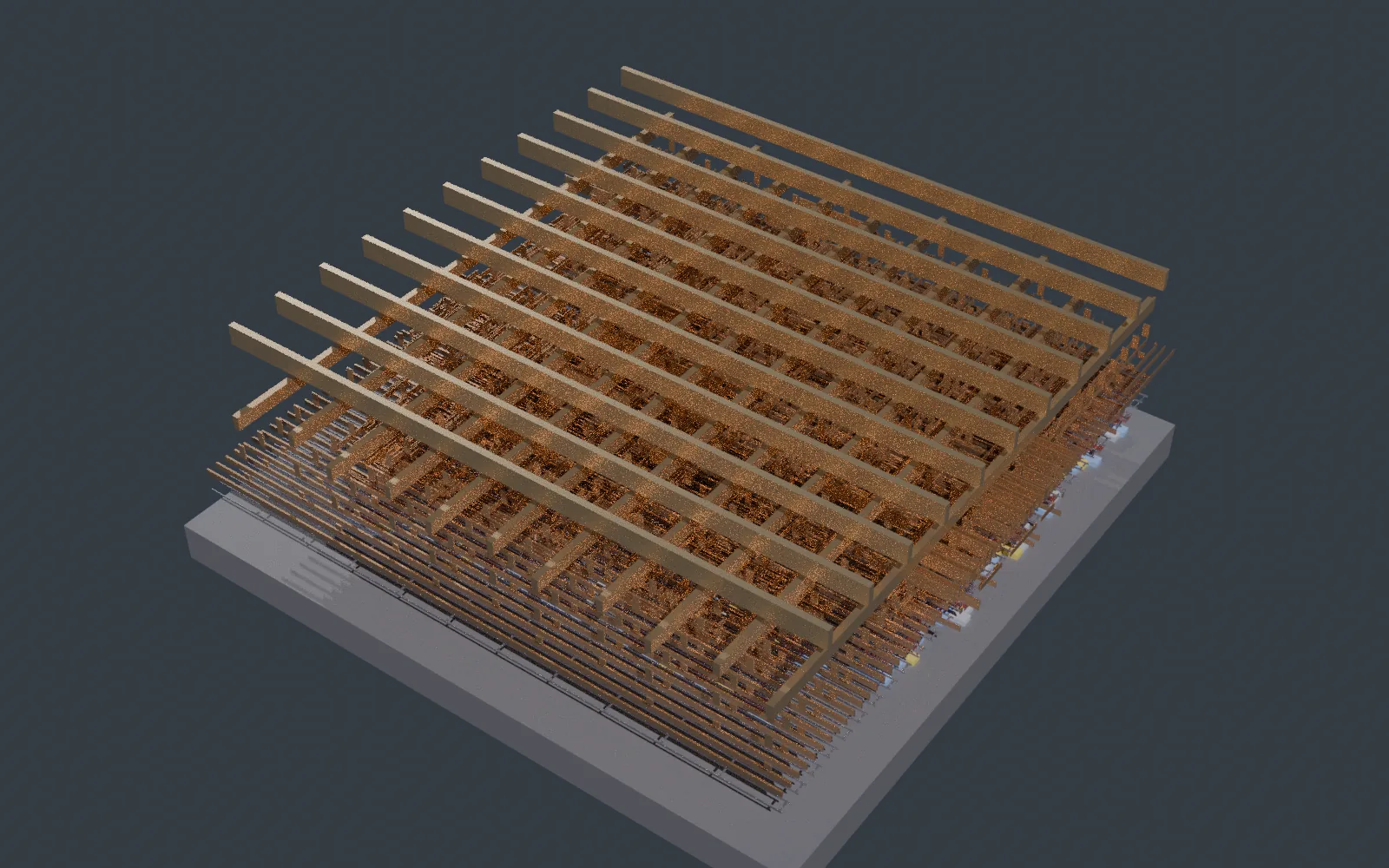 Exploded metal stack · Blender, from the GDS
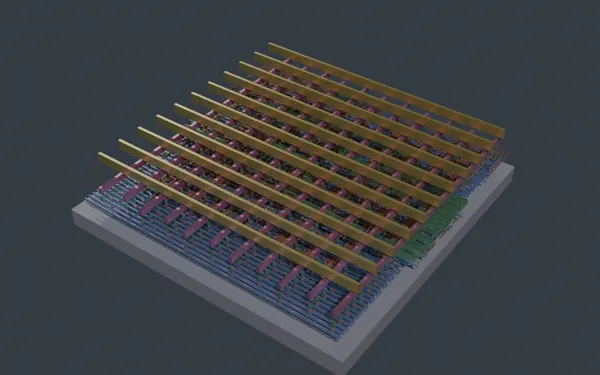
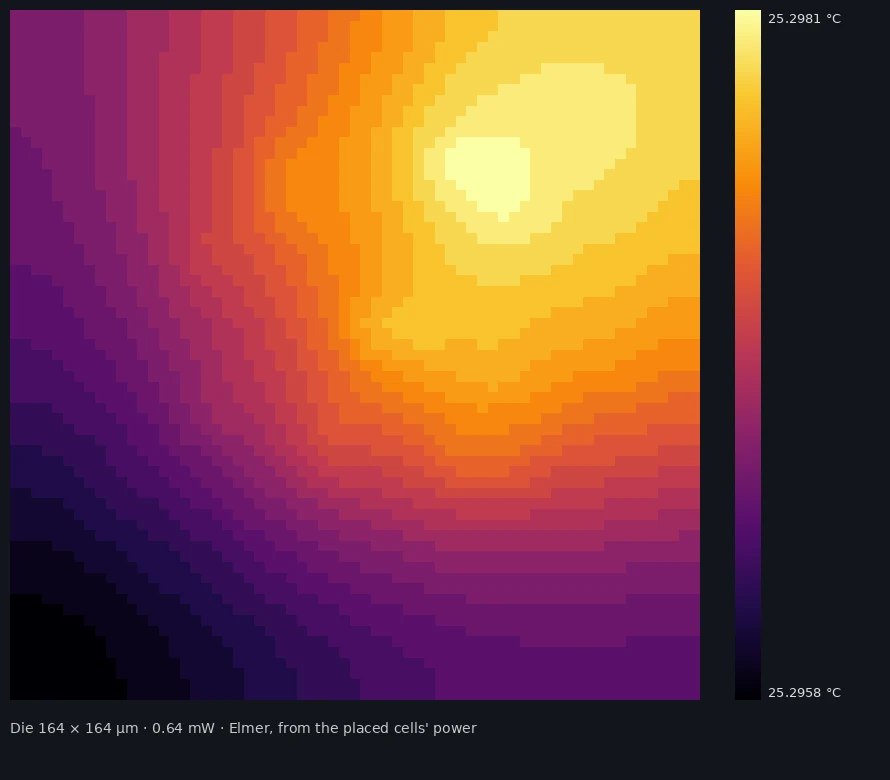
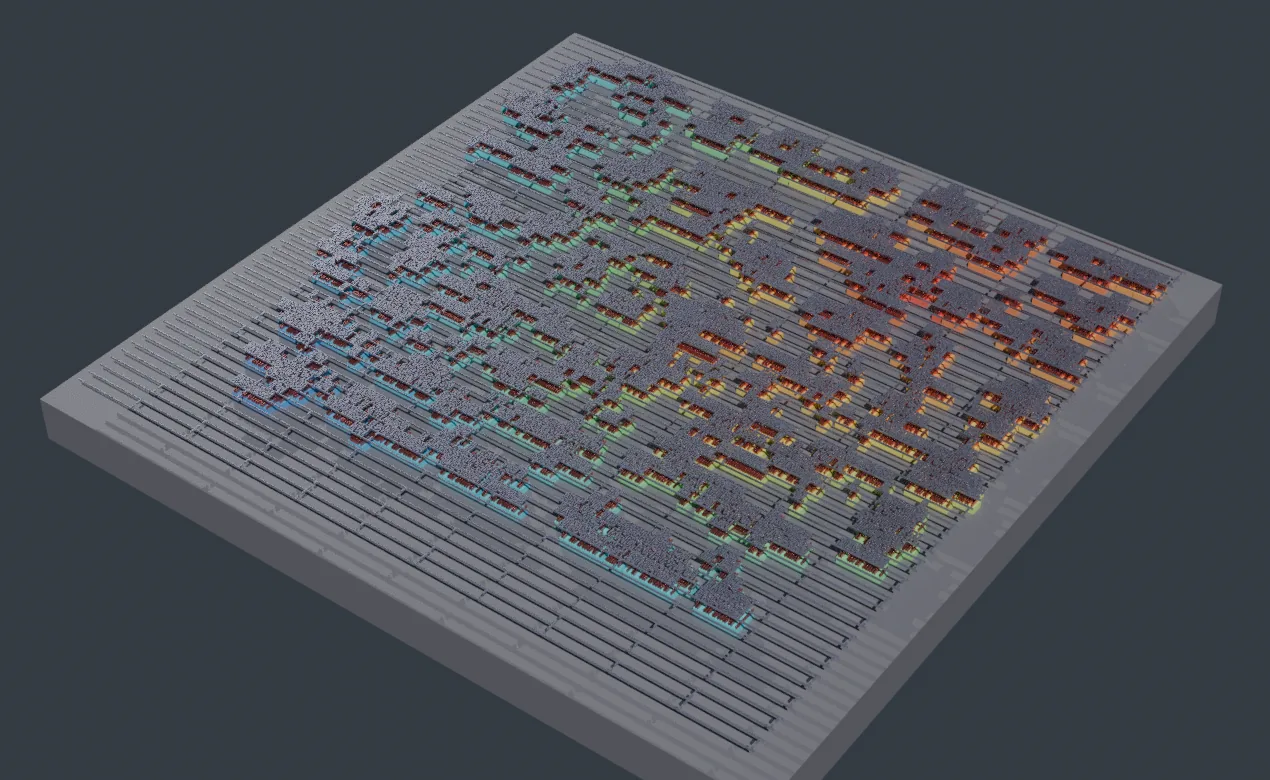
Thermal
Know where the heat goes before the chip exists.
Daedyl takes the power each placed cell draws from the timing analysis, spreads it over the die exactly where the layout put it, and solves the temperature with a finite-element solver. The map lands on the layout and on the 3D model, and every run checks its own energy balance.
0.64 mW
power of the placed cells (OpenSTA)
+0.30 K
peak rise above the sink
164 × 164 µm
die, binned 16 × 16
0.002 %
heat out vs power in
A larger or faster design shows its hot spots the same way, so cooling and placement can be changed while it is still a layout.
Daedyln
An AI engineering agent that works where you work.
Daedyln is built into Daedyl and works directly with the engineering context around it. It can reason over requirements, designs, simulations, results, evidence, and project history while keeping engineers in control of consequential decisions.
Select a transistor
Ask Daedyln about Q1
Understand its operating point, dependencies, results and evidence.
Select a timing path
Explain this violation
Inspect the path, constraints, implementation state and evidence.
Select a requirement
Show supporting evidence
Trace the requirement through design decisions, simulations, results and approvals.
Select a simulation
Compare against an earlier run
Understand what changed, what improved, what regressed and which parameters caused it.
Daedyln does not sit beside the engineering environment. It operates inside it.
Built AI-native
AI isn't a feature bolted onto Daedyl.
Daedyl was designed around collaboration between engineers and AI from the beginning.
Context-aware
Understands the project, selected object, requirements, artifacts, results and history.
Tool-capable
Helps prepare and execute engineering workflows through Daedyl's integrated capabilities.
Evidence-aware
Answers and recommendations can be connected to the evidence that supports them.
Human-controlled
Assists, analyzes, explains and proposes. Engineers retain authority over approvals and consequential decisions.
Security
Control stays with you.
How Daedyl runs today. Ask us about your own deployment requirements.
On infrastructure you control
Daedyl runs on hardware the team owns, on a private network, not on a shared public service.
One sign-in, checked every time
Single sign-on through Daedyl's own identity provider; every request is checked against the project and the person's role.
Every action on the record
Changes, runs, approvals and Daedyln's own actions are written to an append-only audit history.
Approvals by people
Consequential approvals need a person with the right role; any AI approval must be granted explicitly and is labelled as the AI's.
Engineering platform
One interface. Deep engineering underneath.
Daedyl brings specialized design, simulation, verification, optimization and analysis capabilities into one environment.
Digital Design
RTL · Synthesis · Physical Design · Timing · Verification
Sample project, recorded simulation.
Circuit & RF
Circuit Simulation · RF Analysis · Noise · Electromagnetics
Multiphysics
Thermal · Fields · Device Physics · Coupled Analysis
Process & Materials
Process Modeling · Materials · Device Modeling
PCB & Systems
PCB Design · Architecture · System Modeling
Engineering evidence
Every number should have a history.
Daedyl connects requirements, design decisions, artifacts, simulations, results, and human approvals so engineers can understand not only what a result says, but how it came to exist.
Explore evidence- REQ-001Requirement
Gain ≥ 25 dB
- DEC-017Design decision
Cascoded LNA architecture
- SIM-042Simulation
AC and noise analysis
- RES-071Result
Gain 28.6 dB at 10 GHz
- APP-012Approval
Design review
Example on the sample project. The result is its recorded simulation; the record IDs are illustrative.
What Daedyl can do today.
An AI-native environment for engineering work.
RF & Analog
Circuit simulation, S-parameters, noise, electromagnetic and thermal analysis.
Digital IC
RTL, synthesis, physical design, timing, DRC/LVS and GDS workflows.
Design Exploration
Parameter sweeps, optimization, sensitivity analysis and candidate comparison.
Evidence & Provenance
Trace requirements through decisions, artifacts, simulations, results and approvals.
Daedyln
Context-aware AI engineering assistance throughout the project lifecycle.
Compute
Execute engineering workloads through managed or controlled compute infrastructure.
Built for engineering organizations where mistakes are expensive.
- 01
Defense & Aerospace
Engineering workflows where traceability, controlled execution, evidence and human accountability matter.
- 02
Semiconductor Companies
Move from requirements through design, implementation, simulation, optimization and verification in one environment.
- 03
Research Labs
Connect models, experiments, simulations, literature, results and engineering decisions without losing provenance.
Questions
Common questions about Daedyl.
Daedyl
Engineering software should show its work.
Design. Simulate. Optimize. Prove.
Build hardware with an AI-native engineering environment where Daedyln works alongside your team and every important result can be traced back to the engineering that produced it.
Request access
Daedyl is opening to a small number of teams first. A way to ask for access will be here soon. Nothing is collected on this page.